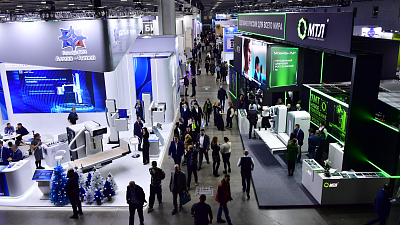

Discussions of new products at Russian Healthcare Week 2025: overview of technologies that media write about
Russian Healthcare Week 2025 has become a showcase of technological innovations. It shows new solutions for diagnostics, surgery, rehabilitation, emergency care, and medical tourism. An overview of what the participants of the Week show at the stands has already appeared in the federal and regional media, and these publications clearly show how the industry lives today.
Developments for diagnostics and surgery of Almaz-Antey are ones of the most cited. The publications mention a range of X-ray diagnostic systems: universal systems of the R-600 series, digital complexes Uniarm and Uniarm-fluorograph, as well as a remote-controlled complex Polydiagnost with tomosynthesis, which is positioned as a modern alternative to classic X-ray machines.
The media pays special attention to the Multitrack optical surgical navigation system, which allows surgeons to combine CT, MRI and PET data, plan an intervention, and monitor the position of the instrument in real time. According to publications, the complex is already used in leading Russian clinics, including Kirov Military Medical Academy, where hundreds of high-tech operations have been performed with its help.
The Remotion robotic exoskeleton is mentioned in information about the rehabilitation. It is designed for patients with impaired mobility of the lower extremities and uses an adaptive rehabilitation system: feedback sensors, functional electrical muscle stimulation, and customizable walking modes. The modular design allows the exoskeleton to be customized for children and adults and for different recovery scenarios.
Among the compact solutions for everyday monitoring are a smart thermometer for continuous measurement of body temperature with data transmission to a smartphone and a device for medicinal electrophoresis, designed for use both in clinics and at home. These devices are especially in demand in pediatrics and in the care of patients with limited mobility.
The media say that one of the key innovations of the Week is the first Russian-made MRI-compatible pacemaker Apollo MRI. The device was developed by Rostec State Corporation enterprises and allows patients with severe forms of arrhythmia to safely undergo MRI examinations, which was previously a serious limitation for implant owners.
In the same block, medical refrigerators for vaccines with autonomous operation in case of power outage and solutions for complex equipment of laboratories and blood transfusion stations are presented.
Automotive publications write in detail about what new special vehicles are shown at Russian Healthcare Week 2025. For instance, a special version of the Lada Iskra SW station wagon is designed for medical teams. It is adapted to the needs of medicine with a modified cabin, spaces for patients, and the ability to transport equipment.
A separate block of publications is dedicated to the new Class C ambulance based on the Sollers SF5 van, which is Russia's first resuscitation ambulance of its class with an automatic transmission. The media emphasize that the combination of a diesel engine, an automatic transmission and well-thought-out ergonomics of the cabin facilitates the work of the team and increases comfort for severe patients during transportation.
Among the participants of Russian Healthcare Week are manufacturers of medical equipment and equipment for the daily operation of clinics. Сompanies specialiыing in X-ray diagnostics are bringing lines of digital fluorographs, C-arcs, mobile and portable X-ray machines, mammography systems, as well as high-voltage X-ray feeding devices for various types of units.
The media highlights the displays of manufacturers of functional medical beds, wheelchairs, oxygen concentrators and air recirculators. These solutions directly affect the quality of patient care and rehabilitation both in hospitals and home.
Within MedTravelExpo, which is part of Russian Healthcare Week, different Russian regions have actively demonstrated their capabilities and an integrated approach to rehabilitation from inpatient treatment to resorts.
For example, the resort industry of the Republic of Crimea presents treatment and rehabilitation programmes, including cancer patients, as well as package offers for medical tourism.
The Ryazan region presents the capabilities of its regional healthcare system and a cardio health centre.
The Republic of Chuvashia is presenting medical tourism opportunities in Moscow, offering patients a full cycle from diagnosis and treatment to rehabilitation in one facility.
The Omsk region can be found at the Energy of Health. Place of Power stand. It shows large medical centers, an ophthalmological hospital, and a nutrition center with a line of special nutrition that has no analogues in Russia.
Press Service, EXPOCENTRE AO
Source: Russian media outlets